

Hong Kong Stocks Rebound: Pharma and Semiconductors Lead
Structural Opportunities Behind the Hong Kong Stock Rebound: Pharma, Semiconductors, and AI Chain Lead, Brokerages and Photovoltaics Under Pressure
Keywords: Hong Kong Stock Rebound, Innovative Drugs, Semiconductors, PCB, AI Computing Power, Brokerages, Photovoltaics, Structural Market
Introduction
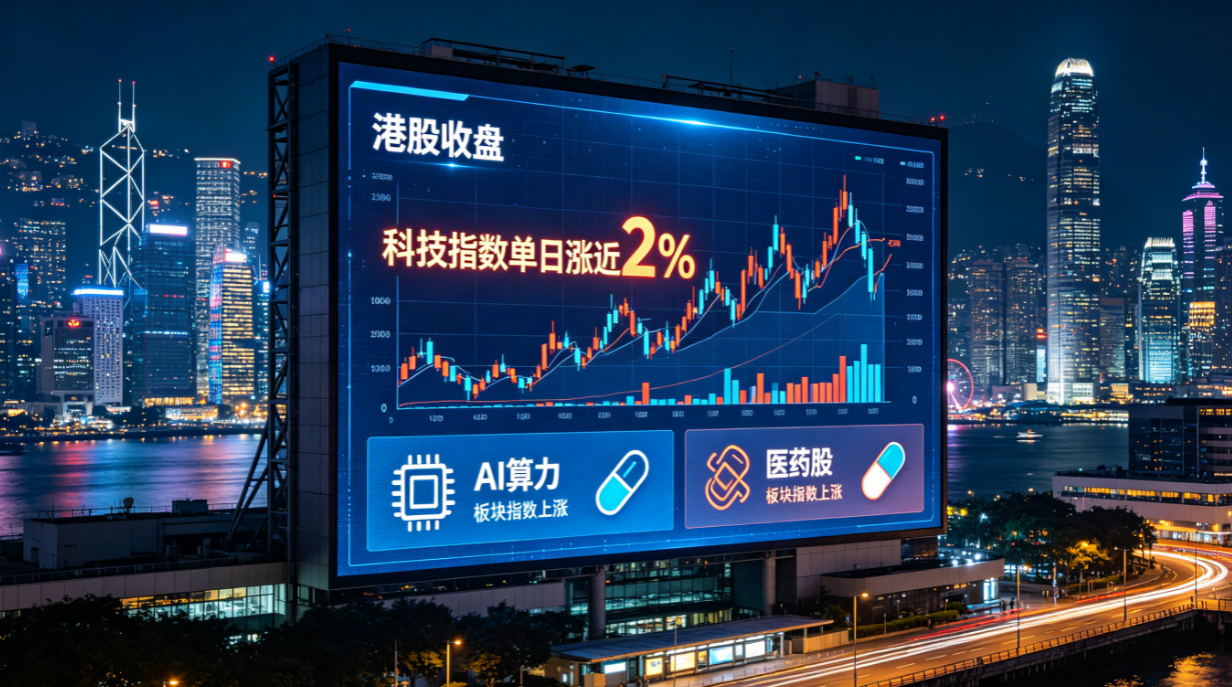
The Hong Kong stock market saw a broad rebound today, with the three major indices recovering simultaneously, significantly improving market sentiment. The Hang Seng Index rose 0.33%, the Tech Index rose 1.81% showing stronger relative performance, and the H-share Index edged up slightly. On the surface, capital did not spread out widely but continued to focus on high-growth, high-elasticity, and high-catalyst sectors, with pharmaceuticals, semiconductors, and PCB-related stocks performing prominently; in contrast, brokerages and photovoltaics saw some pullback. Overall, the short-term repair in Hong Kong stocks more reflects the concentrated release of structural opportunities rather than the full return of a broad rally.
1. Moderate Index Rebound, Tech Sector Takes the Lead in Repair
From the index performance, the Hang Seng and H-shares had limited gains, but the Tech Index strengthened significantly, indicating capital still prefers directions with stronger growth attributes and clearer fundamental improvement expectations. The recovery of tech stocks was partly driven by spillover from the US tech chain sentiment and partly due to Hong Kong stocks' still relatively low valuations. In the current macro environment lacking strong trend breakthroughs, the Hong Kong stock rebound relies more on industry logic and event catalysts, naturally making the tech sector a priority for capital.
Notably, today's market is not just a pure sentiment rebound but focuses on sectors with medium- to long-term industry logic such as innovative drugs, semiconductors, and AI computing power. This means capital allocation in Hong Kong stocks is shifting from defense to offense, but the offensive path remains highly focused.
2. Pharma Sector Valuation Repair, Long-term Logic of Innovative Drugs Continues to Materialize
The pharma sector performed strongly today, with Asymchem rising over 13%, and leading stocks like Genscript Biotech and WuXi AppTec also climbing, becoming one of the market's core directions. The rise in pharma stocks is underpinned by both valuation repair and dual support from fundamentals and event catalysts.
From an industry perspective, the long-term upward trend of innovative drugs has not changed. With continuous improvement in R&D capabilities of domestic innovative drug companies, frequent clinical progress and overseas BD transactions, industry value reassessment is gradually unfolding. Recently, multiple innovative drug clinical data reads met or exceeded expectations, and some major BD targets were announced, providing strong sentiment boosts to the market. For the Hong Kong pharma sector, previously constrained by capital pressure and risk appetite contraction, valuations were at relatively low levels, and when fundamentals marginally improve, elasticity is often quickly amplified.
More importantly, innovative drugs are not just a trading trend. With order fulfillment and performance improvement, industry chain companies are expected to gradually enter a positive cycle of "R&D investment - result transformation - commercial scaling." For investors, this means the pharma sector rebound is not just short-term sentiment driven but could be the starting point for a medium- to long-term valuation restructuring.
3. Semiconductors and PCB Active Simultaneously, AI Computing Chain Continues to Transmit
The semiconductor sector also performed well today, with Hua Hong Semiconductor rising over 15%, and core stocks like SMIC and OmniVision showing significant gains. Hua Hong's leading increase is mainly related to its major asset restructuring plan. The market generally believes that such M&A integration not only helps strengthen industry synergy but also reflects continued progress in the domestic semiconductor industry in terms of policy support, capital operations, and industry integration.
The strength of the semiconductor sector essentially stems from the dual logic of domestic substitution and cycle repair. Currently, the global semiconductor industry is transitioning from traditional cyclical fluctuations to AI-driven growth, with advanced processes, specialty technologies, memory, packaging and testing benefiting to varying degrees. Although Hong Kong-listed semiconductor stocks are less abundant than A-shares, leading companies have strong scarcity in the capital market, and once industry catalysts emerge, stock price elasticity is often large.
Meanwhile, the PCB and upstream material direction was also driven by the surge in AI computing power demand. Stocks like Kingboard Laminates rose, reflecting continued market enthusiasm for high-end PCBs, high-frequency high-speed materials, and server supporting demand. With the rapid increase in global AI server, data center, and high-performance computing demand, the PCB industry is entering a new round of capacity expansion. Industry statistics show that multiple PCB manufacturers have announced capacity expansions this year, with investment heavily concentrated in high-end production capacity such as high-layer, HDI, and IC substrates. This indicates that industry chain demand is not a short-term pulse but continuous investment for next-generation computing infrastructure.
From an investment perspective, the transmission from the AI industry chain to PCBs, copper-clad laminates, semiconductor equipment and materials is still ongoing. As long as computing power demand maintains high prosperity, the performance and valuation of related upstream sectors will have support for some time.
4. Brokerages and Photovoltaics Pull Back, Reflecting Capital's Repricing of Prosperity
In contrast to the strength of tech growth sectors, brokerage stocks generally fell today. GF Securities, CSC Financial, and GLT Guolian Xinxiang all saw significant declines. On the news front, the new requirement to suspend the increase in manager scale for cross-border TRS triggered market concerns about some brokerages' derivatives and cross-border business increments. Although industry estimates suggest this business has limited impact on overall industry revenue, the brokerage sector itself is highly sensitive to policy expectations and capital trading, making it more prone to pullbacks under news disturbances.
However, from a longer-term perspective, the core variables for the brokerage sector remain market trading activity, capital market reform progress, and continued expansion of wealth management and institutional business. This pullback reflects more short-term business incremental expectation setbacks rather than systematic deterioration of industry fundamentals.
The photovoltaic sector also underperformed today, with stocks like Flat Glass, Triumph New Energy, and Xinyi Solar falling significantly. The photovoltaic industry is still in a deep adjustment phase, with low industry chain prices, slowing terminal installation growth, and generally pressured corporate earnings. Institutional views indicate that before H1 2026, the industry will still be in a process of supply-side clearance and capacity restructuring. In other words, the photovoltaic sector's logic is more about "clearance" than "recovery," with accelerated exit of tail-end capacity likely being the main theme for some time, but a true cyclical upturn still requires improved supply-demand dynamics.
5. Individual Stock Moves Reveal Industry Trends, AI and Autonomous Driving Chain Worth Watching
Besides sector rotation, individual stock catalysts provide new observation windows. Cambridge Technology rose significantly today, driven by Nvidia's public interpretation of the Rubin full liquid cooling solution. Nvidia emphasized that liquid cooling technology can achieve more efficient heat dissipation and energy optimization in high computing density scenarios, meaning AI server cooling solutions will further evolve toward high performance and low energy consumption. Cambridge Technology's layout in liquid cooling and optical module related businesses makes it an important beneficiary of industry chain sentiment.
Another stock worth watching is 51World. Its SimOne4.0 has completed deep adaptation and product-level integration with NVIDIA Cosmos 3 and Alpamayo, further advancing the technology chain of "real data reconstruction - world model generalization generation - VLA closed-loop reasoning validation." Such progress not only shows AI's landing capabilities in simulation, autonomous driving, and robotics but also indicates that some small- to mid-cap tech companies in Hong Kong are leveraging top ecosystems for technology upgrades and business expansion.
From an investment logic perspective, the commonality of such stocks is that they may not have the stable cash flow of traditional blue chips, but they can more acutely reflect the progress of new technology industrialization, thus showing significant elasticity when market risk appetite recovers.
Conclusion
Overall, today's Hong Kong stock rebound has clear structural characteristics: capital focused on innovative drugs, semiconductors, PCB, and AI computing power chains, driving the Tech Index to lead; while brokerages and photovoltaics fell due to policy disturbances and prosperity pressure. The market style has not shifted to full aggression but tends to find phased opportunities in more certain growth tracks.
For future movements, whether Hong Kong stocks can further repair depends on three aspects: first, whether tech growth sectors can sustain performance and event catalysts; second, whether macro liquidity and risk appetite continue to improve; third, whether the policy environment provides clearer support for strategic industries like innovative drugs and semiconductors. If these conditions continue to materialize, Hong Kong stocks are expected to maintain structural upward movement amid volatility; if external disturbances increase, capital will still favor high-growth and high-elasticity sectors as main allocation directions.

Disclaimer: This article is for reference only and does not constitute investment advice. Investment involves risks, please invest cautiously.

US Stocks Kick Off August with Volatility: Nasdaq Consolidates at Highs, Rotation Shifts to Defensive Sectors – How Should Asian Investors Respond?
2026-08-05
Fed Holds Rates Steady, Hints at September Cut; U.S. Stocks Rally Across the Board
2026-07-28
Tech giants' earnings beat expectations, pushing US stocks to record highs; Nasdaq leads global markets
2026-07-27