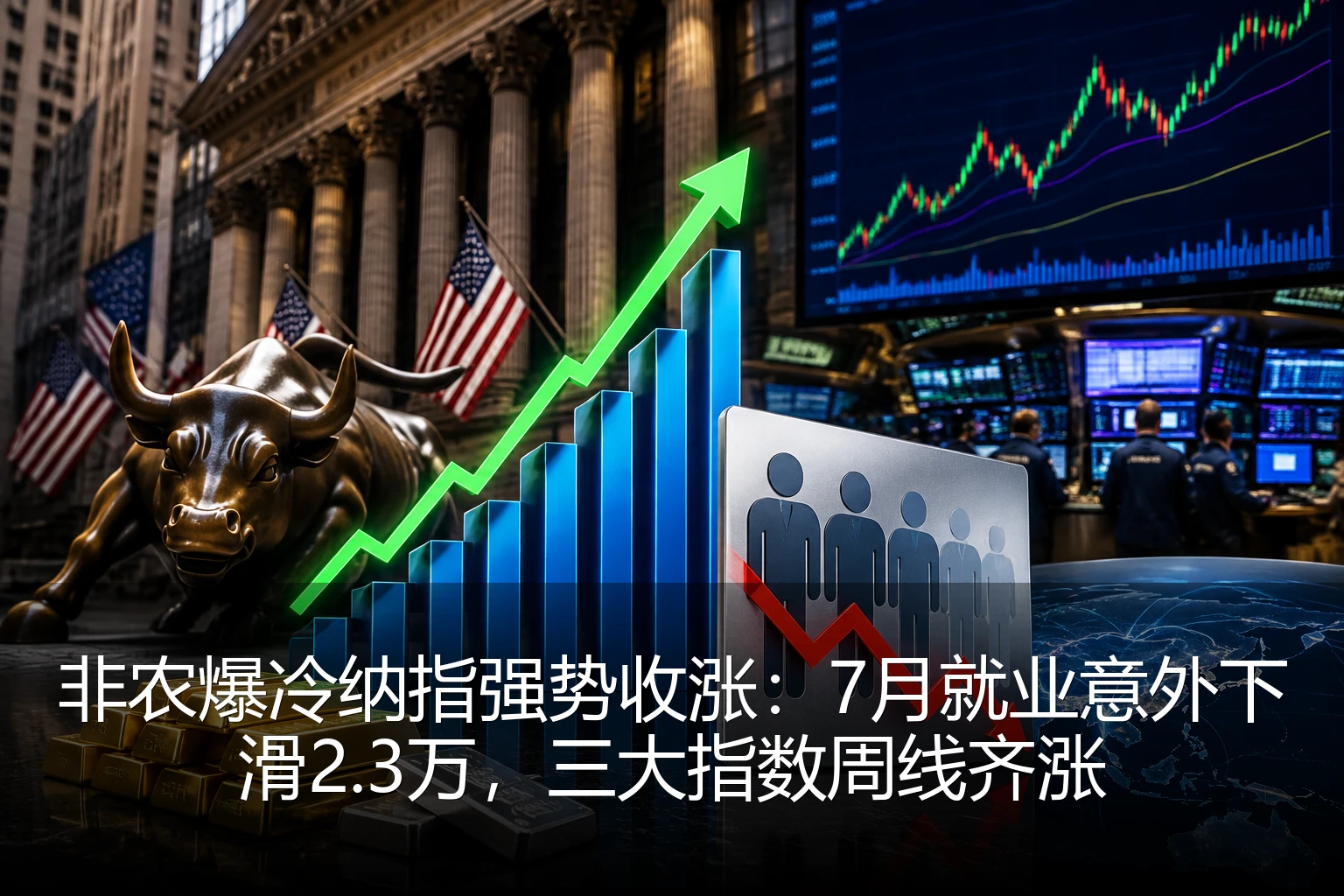
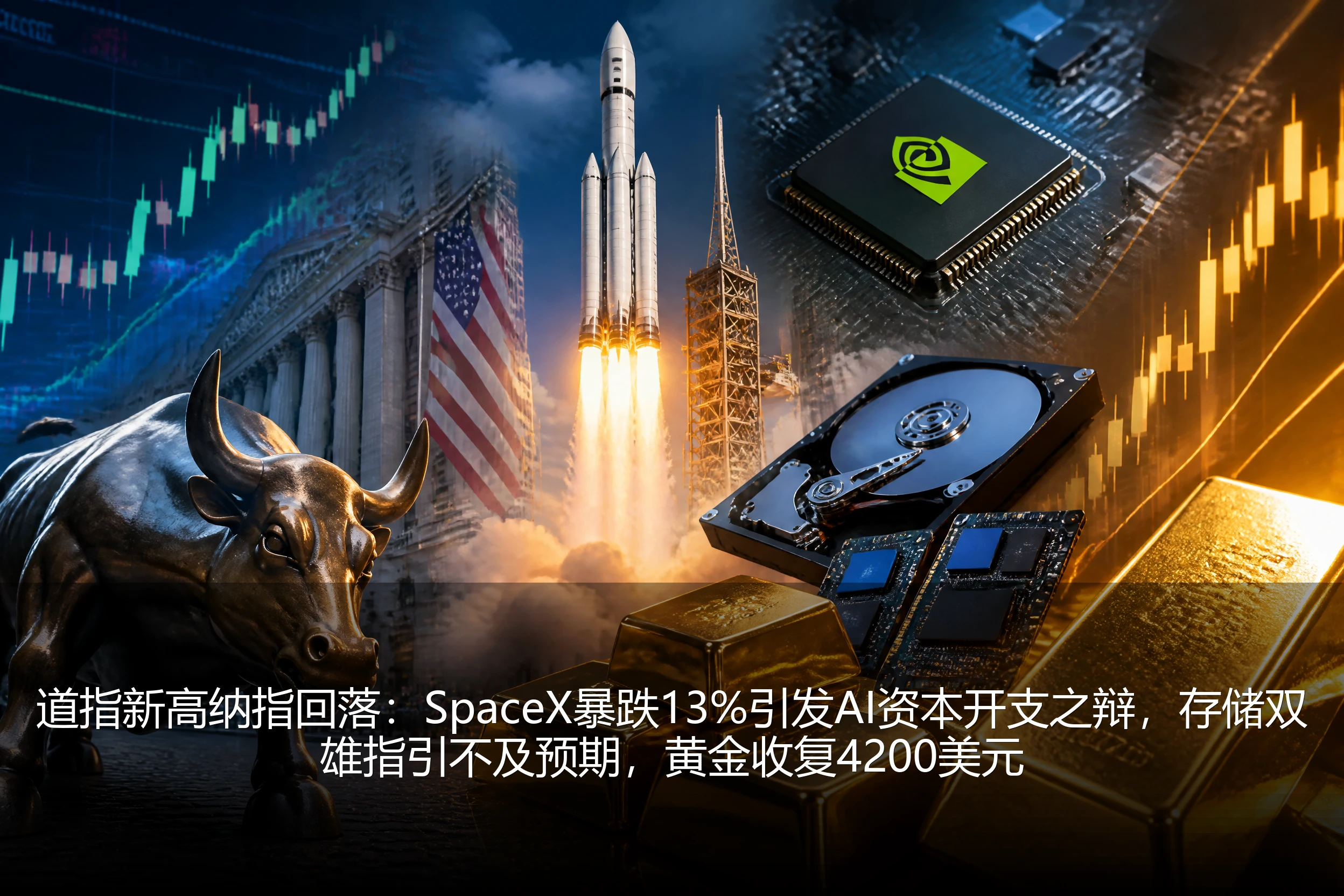
On the night of August 6th (early morning of August 7th Beijing time), US stocks witnessed a volatile tug-of-war between bulls and bears that left global investors holding their breath. During the opening session, the Nasdaq Composite and the AI hardware sector faced collective pressure, with memory chip stocks experiencing a temporary "crash," and market pessimism pervading; however, just a few hours later, the Philadelphia Semiconductor Index recovered over 2% of its opening loss and turned upward, leading memory chip leaders to surge, and the optical communication sector to strengthen, making a "major reversal" the defining feature of the night's US stock market. Meanwhile, the Dow Jones Industrial Average opened higher but trended downward, plunging over 300 points during the session. The significant divergence between the Nasdaq and the Dow painted a complex picture of the current structural trends in the US stock market.
I. Market Review: AI Hardware Stocks Exhibit a "V-shaped Reversal"
From the market data before closing, the trends of the three major US indices showed clear divergence: the Dow initially fell by over 300 points, while the Nasdaq opened lower but rose, largely returning to a flat state, and the S&P 500 narrowed its decline to about 0.2%. The Nasdaq 100, which has a higher weighting of technology stocks, initially fell by over 1% at the open but turned upward during the session, driven by bottom-fishing funds. What surprised the market the most was the dramatic fluctuation in the AI hardware sector—the Philadelphia Semiconductor Index initially dropped by about 2% after opening, but was strongly pulled back by funds, ultimately closing up over 1%, forming a sharp contrast with the opening trend.
The memory chip sector was the most dramatic focus of the night: it initially declined as a group, showing a "crash" state, but was subsequently flooded with buying at lower prices, with individual stocks turning up or significantly narrowing their losses, forming a textbook V-shaped reversal. Sectors related to the AI computing chain, such as optical communication and semiconductor equipment, also led in gains. This pattern of "killing first, then pulling up" indicates that market divergence regarding the AI hardware sector is increasing, but funds positioned for a rebound remain active, with both bulls and bears engaging in intense chip battles at the current levels.
II. Earnings Breakdown: Why Did Stock Prices Fall Despite "Explosive" Results?
The direct trigger for the memory chip market's volatility was the consecutive earnings reports from Western Digital and SanDisk, favored concepts in artificial intelligence. From a fundamental perspective, both reports were "explosive"—both revenue and profit indicated that data storage demand remained very robust, and the pull effect of AI data centers on high-capacity storage products was still being realized.
However, the stock prices of both companies faced pressure during the morning trading after the earnings releases, rooted in the market's sensitivity to "guidance." SanDisk's guidance for the first quarter was slightly below analyst expectations: the company projected adjusted earnings per share of $44 to $46, with revenue between $10.3 billion and $10.8 billion; whereas previous analyst forecasts were $44.72 and $10.82 billion. Western Digital's guidance was generally in line with expectations, projecting adjusted earnings per share of $3.85 to $4.15 and revenue of $4 billion to $4.2 billion, which was largely consistent with the market expectations of $3.84 and $4.06 billion. JJ Kinahan, who oversees the retail business expansion and alternative investment products at the Chicago Board Options Exchange, commented: "After a period of active trading driven by earnings reports, the market seems to be taking a breather. Even when profits and revenue exceed expectations, they do not necessarily drive stock prices up if the earnings guidance is weak." He also pointed out that profit-taking may be a factor in the market—over the past 12 months, Seagate stock has risen by approximately 3000%, and Western Digital has risen by over 530%. It is not uncommon in history for stocks that have seen massive gains to experience a sell-off characterized as 'good news is priced in' after their earnings reports.
The Essence of Expectation Gap: Market Pricing Has Been Pre-disclosed
This case vividly illustrates a core characteristic of the current US stock AI trend: investor expectations for leading companies have become "astonishingly" high. Simply delivering strong results is no longer enough; only comprehensively exceeding expectations—especially exceeding forward guidance—can drive stock prices higher. This is essentially a game of valuation versus profitability: when the speed of profit realization lags slightly behind market imagination, high-level holdings tend to loosen. For investors who habitually judge heroes by earnings figures, this phenomenon of "good earnings, falling stock price" warrants deep consideration.
III. Sector Rotation Signals: AI Capital Shifts from "Broad Gains" to "Selective Picking"
From the "dip and rally" of storage chips to the leading role of optical communication, market capital is undergoing a clear reallocation within the AI hardware industry chain. The Philadelphia Semiconductor Index recovered from a 2% decline and turned upward, indicating that the sector as a whole has not weakened, but capital selection has become more discerning—rotating from the storage segment, which experienced excessive gains previously, to sub-sectors like optical communication and computing networks, which are relatively stagnant or maintaining continuous growth.
This rotation is underpinned by a clear industrial logic: the large-scale construction of AI data centers requires not only storage chips but also high-speed optical modules and optical communication devices for efficient interconnection of computing clusters. With the explosion of demand for large model training and inference, the prospects and certainty of the optical communication industry chain are rapidly increasing, making it a natural destination for capital seeking the "next growth point." Meanwhile, SpaceX is about to undergo its first large-scale unlock after going public—the lock-up period for over 900 million shares is ending, meaning employees and early investors can begin selling their holdings, which adds new uncertainty to the short-term fluctuations of the technology sector, leading some capital to make defensive adjustments before the event materializes.
IV. Geopolitical Disturbance Reappears: Oil Price Rise and Dow Jones Plunge
In addition to corporate earnings and lock-up factors, geopolitical risks have stirred the market again at the end of the trading day. According to Iranian media, the Iranian parliament is reviewing a draft law aimed at strengthening the control over transit rules in the Strait of Hormuz and the Persian Gulf. The content includes prohibiting vessels associated with hostile countries such as the US and Israel, restricting the transportation of related goods, and imposing fines of up to 20% of the cargo value for violations. Although this proposal is still under review and has not been approved, the news caused international oil prices to rise rapidly, and the Dow Jones subsequently plunged. Meanwhile, the market continues to monitor the progress of the agreement between Iran and Oman to reopen the Strait of Hormuz. Jim Reed, a strategist at Deutsche Bank, reminded investors in a report: "In this conflict, the market has experienced multiple false dawns. Although details are becoming clearer, the focus is shifting from whether an agreement will be reached to what the final arrangement will look like, including the unresolved issue of whether Iran will ultimately be allowed to charge tolls to vessels using the strait." This statement implies that oil and geopolitical factors will remain significant variables disrupting US stocks in the short term, especially cyclical sectors, and any news volatility could trigger sharp intraday fluctuations.
V. Implications for Asian Investors
For investors operating in Asian time zones and referencing overnight US stock movements, the major reversal on the evening of August 6th offers several key takeaways:
- Beware the "Expectation Gap" Trap: As the AI trend enters a deep phase, the "good or bad" of earnings can no longer be judged solely by revenue and profit; the comparison between forward guidance and market expectations is what determines the short-term stock direction. When researching stocks, analysts' consensus expectations should be included in the core observation framework.
- Pay Attention to Sector Rotation Rhythm: The intraday reversal in memory chips and the strength in optical communication indicate that internal rotation within AI hardware is accelerating. Instead of chasing already surging hot stocks, focus on niche segments with spillover momentum and relatively reasonable valuations.
- Value Event-Driven Risks: Events such as the large-scale declassification by SpaceX or the situation in the Strait of Hormuz can all become short-term volatility amplifiers. Asian investors holding positions overnight should proactively assess the impact of such events on their portfolios and utilize stop-loss and position management tools effectively.
- Maintain Reverence for Liquidity and Volatility: The current significant intraday volatility in US stocks, with both "sell first, then rally" and "open high and decline" patterns existing, indicates high divergence between bulls and bears. For investors seeking stability, building positions in tranches and controlling daily risk exposure is far more important than betting on a unidirectional trend.
Overall, US stocks performed strongly at the start of August, driven by AI profitability, with the S&P 500 index's monthly market cap increase exceeding $2 trillion at one point, but internal market divergence and volatility are also increasing simultaneously. The "explosive earnings yet sold off" of memory giants, the V-shaped reversal of AI hardware stocks, and the divergence between the Dow and Nasdaq all point to one signal: the AI trend is transitioning from an "era of general rise" to a new phase of "focused refinement." For Asian investors, understanding the expectation gap, grasping the rotation rhythm, and respecting event risks will be the crucial lessons for achieving excess returns in the US stock market. (This article is compiled based on public market information and does not constitute investment advice. Markets are risky, and investment requires caution.)